What Is a Crawl-Through Log? Everything Buyers Need to Know
Crawl-through logs show up in zoos, schools, playgrounds, and backyards — but what exactly are they, how are they made, and where do you actually buy a real one?

What Is a Crawl-Through Log? Everything Buyers Need to Know
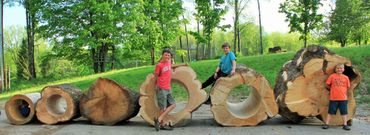
You've seen them. A massive section of timber, lying on its side, with a perfectly round hole bored clean through from one end to the other. A child disappears into one end and emerges from the other. A red panda uses one as a den. A school installs one on the playground and it becomes the most popular piece of equipment on the grounds.
That's a crawl-through log. And if you're trying to buy one, this guide will tell you everything you need to know.
What Exactly Is a Crawl-Through Log?
A crawl-through log — also called a hollow log, tunnel log, or crawl log — is a section of reclaimed timber that has been bored hollow from end to end. The result is a natural wood cylinder with an open passage running through its center.
The key distinction from a naturally hollow log (the kind you find in a forest) is that a crawl-through log is manufactured to consistent specifications. The bore diameter is precise. The interior is smooth enough to prevent splinters. The structural integrity is maintained through the boring process. And the log is treated to withstand outdoor use.
This is not a simple product to make well. It took Bob Kilgore, founder of IC WOOD, years of development to create the patented Inner Circle Wood Method — the process that makes consistent, safe, mass-produced crawl-through logs possible.
What Are Crawl-Through Logs Used For?
The applications are broader than most people realize:
Natural playgrounds and school grounds. Crawl-through logs are one of the most popular elements in nature-based play environments. Children are instinctively drawn to enclosed spaces, and a real log tunnel provides a sensory experience that no plastic alternative can match.
Zoo and aquarium enrichment. Hollow logs are used extensively in zoo exhibits as behavioral enrichment structures. Animals use them as dens, hiding spots, climbing structures, and foraging sites. IC WOOD logs are used in 130+ AZA-accredited zoos across North America, including the Smithsonian's National Zoo, San Diego Zoo, and Columbus Zoo.
Wildlife rehabilitation centers. Rehab centers use hollow logs to provide natural den structures for recovering animals — everything from foxes and raccoons to raptors and reptiles.
Public parks and nature centers. A large crawl-through log installed in a park or nature center becomes an instant landmark. Adults and children alike are drawn to interact with it.
Residential backyards. Homeowners with large dogs, outdoor cats, or children install hollow logs as play and enrichment structures. They're also used as decorative natural elements in landscape design.
Reptile and exotic pet habitats. Large reptiles — iguanas, monitor lizards, large tortoises — use hollow logs as hides and basking structures. The non-toxic, natural material is ideal for animal contact.
How Is a Crawl-Through Log Made?
This is where most people are surprised. Making a crawl-through log that is safe, structurally sound, and consistent in its bore diameter is genuinely difficult. Here's why.
A log is not a uniform material. It has grain variations, knots, moisture gradients, and natural imperfections. Boring a clean, consistent hole through a 5-foot section of timber — without splitting the log, without creating interior splinters, and without compromising the structural walls — requires specialized equipment and technique.
The traditional approach is chainsaw hollowing. A skilled craftsperson uses a chainsaw to carve out the interior of a log. The results are inconsistent — bore diameters vary, interior surfaces are rough, and structural integrity depends entirely on the skill of the individual doing the work. Chainsaw-hollowed logs are also slow and expensive to produce at scale.
IC WOOD's patented Inner Circle Wood Method uses a purpose-built boring process that produces a consistent, smooth interior bore in a fraction of the time. The result is a log that meets precise specifications every time — the same bore diameter, the same wall thickness, the same interior smoothness — regardless of which log it came from.
This consistency is what makes IC WOOD logs safe for children and animals. It's also what makes them possible to produce at the volume needed to supply zoos, schools, and parks across North America.
What Wood Is Used?
IC WOOD logs are made from reclaimed hazard timber — trees that have been identified for removal due to disease, storm damage, or development. These are trees that would otherwise go to a landfill or be chipped into mulch.
By using hazard timber, IC WOOD diverts hundreds of tons of wood from landfills each year while producing a product that lasts decades. It's a genuinely circular use of a natural resource.
The species used varies by availability and region. Most IC WOOD logs are hardwood or mixed species — the specific species is less important than the structural integrity of the individual log, which is assessed before boring.
Bark or No Bark?
IC WOOD logs are available in two exterior finishes:
With bark is the natural look. The bark is left intact, giving the log its authentic forest appearance. Bark does shed naturally over time — this is normal and expected. It's part of how real wood ages. Bark-on logs are ideal for outdoor installations where natural weathering is acceptable.
Bark-free logs have the exterior bark removed, leaving a smooth outer surface. This is the right choice for indoor installations, zoo exhibits with intensive animal contact, or environments where falling bark debris is a concern. The interior bore is identical in both options.
What Sizes Are Available?
IC WOOD produces logs in two standard outer diameters:
- 24-inch outer diameter — the most common size for school playgrounds, residential use, and smaller zoo exhibits. The interior bore diameter is approximately 18 inches.
- 28-inch outer diameter — a larger option for older children, adults, and larger animals. The interior bore is approximately 21 inches.
Custom larger diameters are available for institutional and zoo-scale applications.
Length options range from 2 feet to 6 feet. The right length depends on the application:
- 2 feet: Den or hideout — the animal or child is partially inside
- 3–4 feet: Short tunnel — the user disappears briefly
- 5–6 feet: Full tunnel — the user is completely inside for a moment before emerging
For most playground and zoo applications, 4- to 6-foot lengths provide the best experience.
How Much Does a Crawl-Through Log Cost?
Pricing varies by diameter, length, and bark option. As a general reference:
- A 24-inch diameter, 2-foot log starts around $199
- A 24-inch diameter, 6-foot log runs approximately $1,699
- Bark-free logs are approximately 10% more than bark-on
These are direct-from-manufacturer prices. If you're buying from a reseller, expect to pay more — sometimes significantly more — for the same product.
Use the IC WOOD Log Size and Proportion Helper to get an exact price for your configuration.
Where to Buy a Real Crawl-Through Log
This is where buyers often get confused. Search "crawl through log" or "hollow log" online and you'll find a range of products at a range of prices. Here's what you're actually looking at:
IC WOOD direct — the original manufacturer. Every log is produced using the patented Inner Circle Wood Method. Direct pricing, direct shipping, direct support. This is where every major reseller sources their product.
Resellers — many companies selling hollow logs online are reselling IC WOOD product at a markup. You're getting the same log, paying more for it, and dealing with a middleman if anything goes wrong.
Chainsaw-hollowed logs — these exist, usually from small local craftspeople. Quality varies enormously. Interior smoothness and bore consistency are not guaranteed. For zoo or school applications where safety standards matter, these are a risk.
Plastic or fiberglass "log" tunnels — these are not real wood. They're molded to look like logs but provide none of the sensory, durability, or environmental benefits of real timber.
The safest, most cost-effective option is to buy direct from IC WOOD. You get the original product, manufacturer pricing, and the assurance that every log has been produced to consistent specifications.
Ready to Order?
Use the Build Your Log configurator to spec your exact diameter, length, and bark preference. Or contact us directly — we're happy to help you choose the right log for your application, whether it's a school playground, a zoo exhibit, or a backyard enrichment project.
IC WOOD ships across North America. Every log is made in Taberg, New York, from reclaimed hazard timber, using the only patented hollow log boring process in existence.
Explore Topics
Written by
IC WOOD Team
Content creator and writer sharing insights and stories.