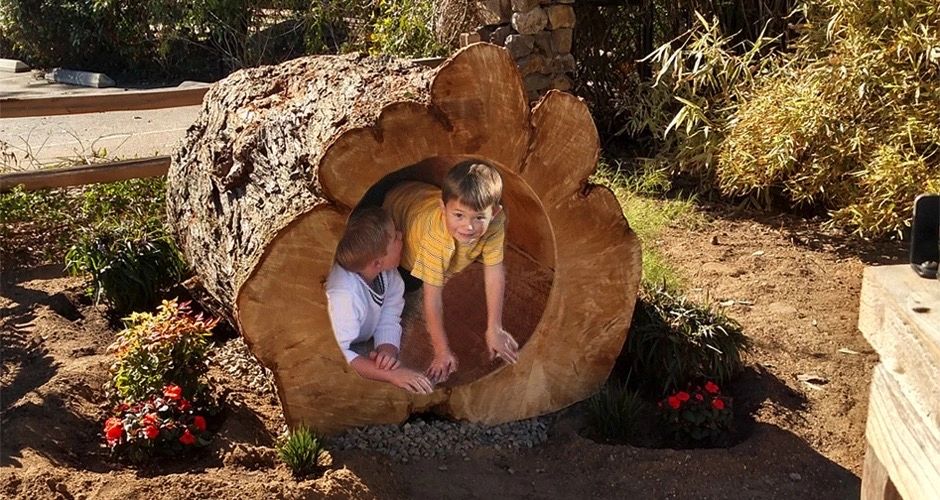
Real Log Tunnels for Playgrounds: What to Know Before You Buy
Not all log tunnels are created equal. Here is what separates a real crawl-through log from a plastic imitation — and why it matters for kids, schools, and parks.
Real Log Tunnels for Playgrounds: What to Know Before You Buy
You've seen them at nature-based schools, public parks, and zoo exhibits — a massive, hollowed-out log lying on the ground, kids disappearing into one end and popping out the other. It looks simple. It isn't.
A real log tunnel is one of the most sought-after pieces of natural play equipment on the market. It's also one of the most misunderstood. This guide covers everything you need to know before you buy one.
What Is a Real Log Tunnel?
A real log tunnel — sometimes called a crawl-through log, crawl log, or tunnel log — is a full-length section of timber that has been bored hollow from end to end. The result is a natural wood tube that children, animals, or visitors can crawl through.
The key word is real. There are plastic and fiberglass products on the market designed to look like logs. They're lighter, cheaper, and easier to ship. They're also nothing like the real thing — in texture, smell, weight, durability, or the sensory experience they provide.
A genuine crawl-through log is made from reclaimed timber. It has bark (or the option of bark-free smooth interior). It smells like a forest. It ages naturally. And it lasts for decades.
Why Schools and Parks Choose Real Wood Over Plastic
The shift toward natural play equipment isn't a trend — it's backed by decades of child development research. Here's what the research consistently shows:
Sensory engagement is deeper with natural materials. The rough texture of bark, the grain of the wood interior, the earthy smell — these stimulate the senses in ways that molded plastic simply cannot replicate. Children engage longer, more creatively, and more physically with natural elements.
Risk calibration improves. Natural play environments — including real log tunnels — present mild, manageable physical challenges. Crawling through a slightly uneven, dimly lit log interior requires spatial awareness and body control. This kind of calibrated risk is exactly what child development experts recommend.
Durability is unmatched. A quality hollow log, properly treated and installed, will outlast any plastic tunnel by a factor of three to five. Many IC WOOD logs installed at zoos and schools in 2015 are still in daily use today.
Environmental alignment. Schools and parks increasingly want their outdoor spaces to reflect natural values. A real log does that. A plastic log shaped like a log does not.
The Sizes You Actually Need
Log tunnels come in a range of diameters and lengths. Getting the sizing right matters — both for the intended users and for the space.
Diameter determines who can use the log. A 24-inch outer diameter is appropriate for small children and most domestic animals. A 28-inch diameter opens up the tunnel for larger kids and adults. Larger custom diameters are available for zoo-scale applications.
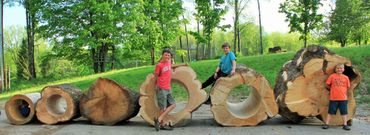
Length determines the experience. A 2-foot log is more of a den or hideout. A 6-foot log is a true tunnel — long enough that the child disappears completely before emerging from the other side. Most school and park installations use 4- to 6-foot lengths for maximum play value.
Bore diameter — the actual interior opening — is determined by the outer diameter and the wall thickness. IC WOOD's patented Inner Circle Wood Method produces consistent bore diameters across every log, something hand-carved or chainsaw-hollowed logs cannot guarantee.
What Makes IC WOOD Different
IC WOOD is the only manufacturer in North America producing mass-market crawl-through hollow logs at scale. Every other reseller you find online — and there are many — sources their logs from IC WOOD or attempts to imitate the process.
The difference comes down to the patent. The Inner Circle Wood Method, developed by founder Bob Kilgore in 2014, uses a specialized boring process that produces a smooth, consistent interior bore without compromising the structural integrity of the log. The result is a tunnel that is safe, splinter-resistant on the interior, and structurally sound enough to support the weight of multiple children at once.
IC WOOD logs are:
- Non-toxic and animal-contact safe — used in 130+ AZA-accredited zoos
- Available bark-free for indoor installations or sensitive environments
- Made from reclaimed hazard timber — trees that would otherwise go to landfill
- Custom-sized from 24 to 72 inches in diameter, 2 to 6 feet in length
- Shipped direct from the manufacturer in Taberg, New York
Bark or No Bark?
This is one of the most common questions buyers ask. Here's the practical answer:
With bark is the classic look. It's visually striking, feels more natural, and is ideal for outdoor installations where the log will weather in place. Bark does shed over time — this is normal and expected. It's part of the natural aging process.
Bark-free is the right choice for indoor installations, zoo exhibits where animal contact is intensive, or environments where falling bark debris is a concern. The smooth exterior is also easier to clean and inspect.
Both options use the same bore process and the same structural timber. The difference is purely in the exterior finish.
Installation: What You Need to Know
A real log tunnel is heavy. A 6-foot, 24-inch diameter log weighs several hundred pounds. Installation requires planning.
Ground contact: Most outdoor installations place the log directly on the ground or on a slight grade to allow water drainage. Logs should not sit in standing water.
Safety surfacing: For playground applications, the area around and inside the log should meet ASTM F1292 impact attenuation standards. Engineered wood fiber, pea gravel, or rubber mulch are all appropriate.
Anchoring: For high-traffic installations, logs can be anchored with ground stakes or set into a gravel bed to prevent rolling.
ADA considerations: Log tunnels are not ADA-compliant play elements by themselves. They should be part of a larger play environment that includes accessible routes and equipment.
Where to Buy a Real Log Tunnel
If you search "log tunnel playground" or "crawl through log" online, you'll find a range of products at a range of prices. A few things to watch for:
- Plastic or fiberglass "log" tunnels — these are not real wood. They're often cheaper but provide none of the sensory or durability benefits of real timber.
- Resellers — many companies selling hollow logs are reselling IC WOOD product at a markup. Buying direct from IC WOOD saves you that margin.
- Chainsaw-hollowed logs — these exist but lack the consistent bore diameter and interior smoothness of a machine-bored log. Splinter risk is higher.
The safest, most cost-effective option is to buy direct from the manufacturer. IC WOOD ships across North America and offers a custom log configurator where you can spec your exact diameter, length, and bark preference before ordering.
The Bottom Line
A real log tunnel is one of the highest-value investments you can make in a natural play environment. It will outlast plastic alternatives, provide richer sensory experiences, and age beautifully in place.
The key is buying the genuine article — not an imitation, not a reseller markup, not a chainsaw-hollowed approximation. IC WOOD is the original. Every major reseller in North America sources from us.
Ready to spec yours? Use the Log Size and Proportion Helper to find the right diameter and length for your space, or contact us with your project details and we'll help you choose.
Explore Topics
Written by
IC WOOD Team
Content creator and writer sharing insights and stories.