Natural Playground Tunnel Ideas: The Case for Real Wood
Planning a natural playground and considering a tunnel element? Here is why a real hollow log outperforms every other option — and how to choose the right one for your space.

Natural Playground Tunnel Ideas: The Case for Real Wood
Natural playgrounds are designed around a simple idea: children play better, longer, and more creatively when their environment reflects the natural world. Tunnels are one of the most universally loved elements in any playground — and in a natural play setting, the tunnel you choose matters more than you might think.
This post walks through the main options for natural playground tunnels, what the research says about each, and why a real hollow log consistently outperforms the alternatives.
Why Tunnels Matter in Natural Play Design
Before getting into materials and options, it's worth understanding why tunnels are so valuable in a play environment.
Tunnels create enclosed, intimate spaces. Children — especially younger ones — are drawn to spaces that feel enclosed and protected. Developmental psychologists call this the "loose parts" principle: children seek environments that offer both challenge and refuge. A tunnel provides both simultaneously.
Tunnels encourage cooperative play. One child goes in, another waits at the exit. They switch. They play peek-a-boo. They dare each other to go through in the dark. These interactions build social skills in ways that open play structures don't.
Tunnels develop spatial and body awareness. Crawling through a confined space requires children to understand their own body dimensions, adjust their movement, and navigate in low visibility. These are foundational sensorimotor skills.
In a natural play environment, the tunnel element should reinforce the overall design philosophy — connection to nature, authentic materials, sensory richness. That's where material choice becomes critical.
The Main Options for Natural Playground Tunnels
1. Real Hollow Logs
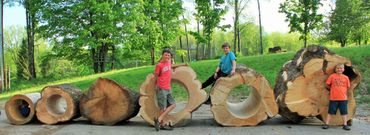
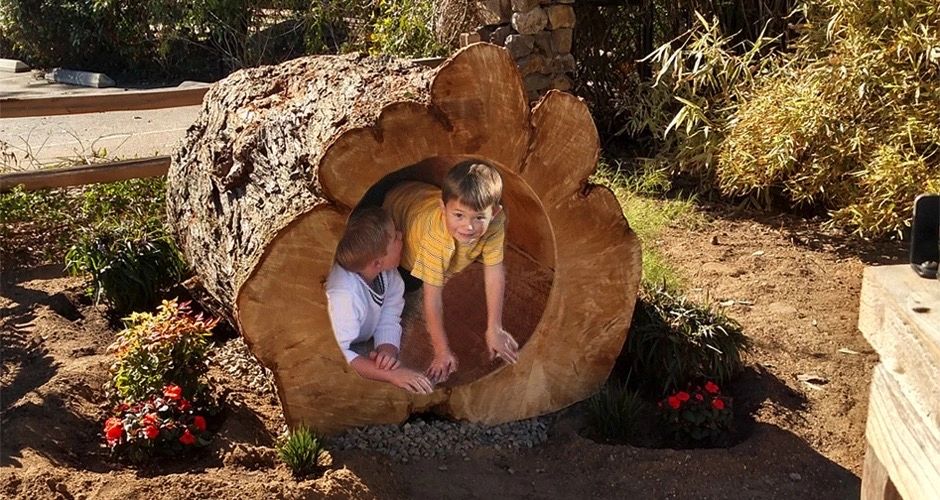
A genuine crawl-through hollow log is the gold standard for natural playground tunnels. It's the only option that is literally made from nature — reclaimed timber, bored hollow, installed in place.
Advantages:
- Authentic natural material — bark, grain, smell, texture
- Extremely durable — properly maintained logs last 15–25+ years outdoors
- Visually anchors the natural play environment
- Non-toxic, safe for intensive child contact
- Ages naturally and beautifully
- Available in a range of sizes to suit different age groups
Considerations:
- Heavier than alternatives — requires planning for delivery and installation
- Higher upfront cost than plastic options (offset by lifespan)
- Bark sheds naturally over time (expected and normal)
2. Plastic or Fiberglass "Log" Tunnels
These are the most common alternative — molded plastic or fiberglass products designed to look like logs. You'll find them in many big-box playground catalogs.
Advantages:
- Lighter and easier to install
- Lower upfront cost
- Consistent dimensions
Considerations:
- No sensory authenticity — smooth, uniform, odorless
- Fade and crack over time in UV exposure
- Shorter lifespan (typically 7–12 years before replacement)
- Does not align with natural play philosophy
- Children and educators notice the difference
The honest assessment: plastic log tunnels are a compromise. They're chosen for budget or logistics reasons, not because they're better. In a genuinely natural play environment, they look out of place.
3. Concrete Tunnel Structures
Some natural playground designs incorporate concrete tunnels, sometimes with natural stone or bark veneer finishes.
Advantages:
- Extremely durable
- Low maintenance once installed
- Can be custom-shaped
Considerations:
- Very high installation cost
- Not a natural material
- Hard and cold to the touch — less sensory engagement
- Permanent — cannot be repositioned
Concrete tunnels work well in permanent, high-budget installations but don't deliver the sensory experience of real wood.
4. Earthen or Mounded Tunnels
Some natural playground designs create tunnels by mounding earth and installing a culvert or frame underneath, then covering with soil and planting grass or groundcover over the top.
Advantages:
- Highly immersive natural experience
- Can be integrated into landscape grading
- Unique visual impact
Considerations:
- Significant construction and landscaping cost
- Drainage must be carefully engineered
- Interior is typically concrete or metal pipe — not natural
- Maintenance-intensive (vegetation management)
These are spectacular when done well but represent a major infrastructure investment.
Why Real Hollow Logs Win for Most Natural Playground Projects
For the vast majority of natural playground projects — school grounds, public parks, nature centers, early childhood environments — a real hollow log is the right answer. Here's why:
It's the only option that is genuinely natural. Every other tunnel option involves manufactured materials at its core. A hollow log is a tree. That's it. The authenticity is total.
The sensory experience is unmatched. Children running their hands along the interior grain, smelling the wood, feeling the temperature difference between the shaded interior and the open air — these are experiences that plastic and concrete cannot replicate. Research on nature-based learning consistently shows that authentic natural materials produce deeper engagement.
The lifespan math works in your favor. A quality hollow log from IC WOOD, properly installed and maintained, will last 15 to 25 years. A plastic tunnel typically needs replacement in 7 to 12 years. Over a 25-year horizon, the real log is often the more economical choice.
It anchors the design. A real hollow log is visually commanding. It becomes the centerpiece of the natural play environment — the element that children remember, that parents photograph, that defines the space.
Choosing the Right Size
IC WOOD produces hollow logs in two standard outer diameters — 24 inches and 28 inches — with custom larger sizes available for zoo and institutional applications.
For preschool and early childhood environments (ages 2–6): A 24-inch diameter, 4-foot length is ideal. Children this age love the enclosed feeling, and the shorter length means they're never out of sight for long.
For elementary school playgrounds (ages 5–12): A 24-inch or 28-inch diameter, 5- to 6-foot length provides a genuine tunnel experience. Older children appreciate the longer crawl.
For multi-age environments: Consider installing two logs of different sizes side by side — one for smaller children, one for older kids and adults. This creates a natural play cluster that serves the full age range.
For nature centers and public parks: Larger diameters and longer lengths create a more dramatic experience. A 28-inch, 6-foot log is impressive at any scale.
Use the IC WOOD Log Size and Proportion Helper to visualize your log in context before ordering.
Installation Tips for Natural Playground Tunnels
A few practical notes for getting the installation right:
Orient for drainage. The log should be positioned so water drains out of the ends rather than pooling inside. A slight grade — even just a few degrees — is sufficient.
Use appropriate safety surfacing. The area around and inside the log should meet ASTM F1292 impact attenuation standards. Engineered wood fiber is the most natural-looking option and works well with hollow log installations.
Consider the sight lines. Playground supervisors should be able to see both ends of the log from a central supervision point. This is both a safety consideration and a practical one — children will use the log more freely when they know adults can see them emerge.
Plan for the weight. IC WOOD logs are heavy. A 6-foot, 24-inch diameter log weighs several hundred pounds. Coordinate delivery access and have a plan for moving the log into position before it arrives.
The IC WOOD Difference
IC WOOD is the original hollow log manufacturer — the company that developed the patented Inner Circle Wood Method that makes mass-produced crawl-through logs possible. Every log is bored with a consistent interior diameter, smooth enough to prevent splinters, and treated to withstand outdoor installation.
IC WOOD logs are used in 130+ AZA-accredited zoos, hundreds of schools and nature centers, and public parks across North America. They're the logs that every major reseller sources — which means buying direct from IC WOOD saves you the reseller markup.
Ready to add a real hollow log to your natural playground? Browse the store, use the configurator, or get in touch with your project details.
Explore Topics
Written by
IC WOOD Team
Content creator and writer sharing insights and stories.