How to Choose a Hollow Log for Your Natural Playground
Natural playgrounds are replacing plastic equipment at schools, nature centers, and parks across the country. A hollow log is one of the most versatile — and beloved — elements you can add. Here's how to choose the right one.
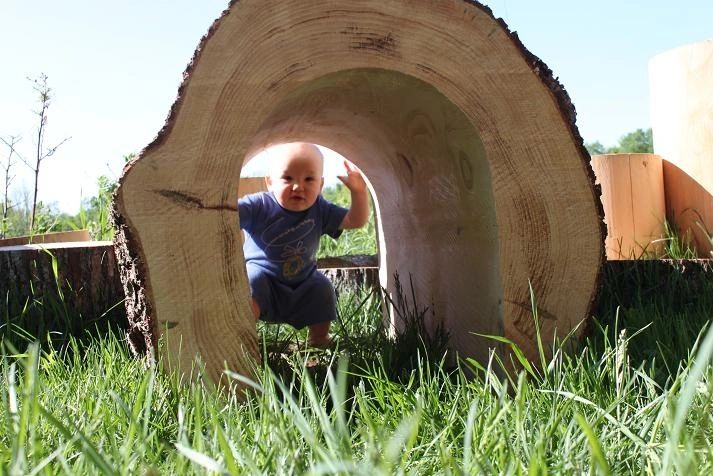
There's a moment every natural playground designer knows: the moment a child sees a hollow log for the first time and immediately crawls inside.
No instructions needed. No demonstration. Just pure, instinctive play.
That's the power of natural elements in play spaces — and it's why hollow logs have become one of the most requested features in natural playground design across North America.
What Is a Natural Playground?
A natural playground replaces traditional plastic and metal equipment with elements drawn from the natural world: boulders, logs, water features, sand, native plantings, and landforms. The goal is to create a play environment that encourages open-ended, imaginative, and physically challenging play — the kind that develops balance, coordination, risk assessment, and creativity.
Research consistently shows that children in natural play environments are more physically active, more socially engaged, and more focused when they return to the classroom than children who play on traditional equipment.
Why Hollow Logs Belong in Every Natural Playground
A hollow log isn't just a piece of wood. It's a tunnel, a fort, a stage, a hiding spot, a balance beam, a drum, and a home base — all at once, depending on who's playing and what story they're telling.
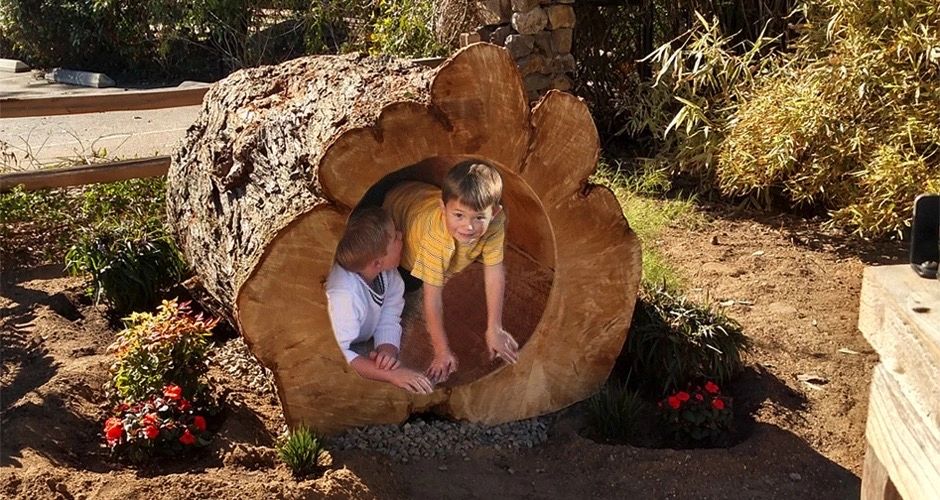
For younger children (ages 2–5): A hollow log is a den. They crawl in, peek out, and feel the primal satisfaction of having their own enclosed space. This kind of "cozy corner" play is developmentally important for building a sense of security and independence.
For school-age children (ages 6–12): The log becomes a prop in elaborate imaginative play — a pirate ship, a dragon's cave, a secret headquarters. It also provides genuine physical challenge: climbing over, balancing on, and crawling through a large log requires real coordination.
For all ages: The texture, smell, and visual character of real wood engages the senses in ways that plastic simply cannot. Children touch it, smell it, listen to it when they knock on it. It connects them to the natural world in a direct, tactile way.
Choosing the Right Size
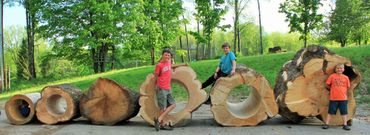
IC WOOD hollow logs are available in diameters from 24 inches to 72 inches. Here's how to think about sizing for a playground context:
24" diameter (The Cub Hollow): Best for toddler areas and sensory gardens. Children can sit inside but not fully crawl through. Great as a standalone feature or paired with larger logs.
36" diameter (The Explorer Trunk): The most popular size for elementary school playgrounds. Most children ages 5–12 can crawl through comfortably. Versatile enough to use as a tunnel, a balance log (positioned on its side), or a den.
48" diameter (The Grand Hollow): Ideal for larger play spaces and older children. Two or three children can sit inside together. Creates a genuine "room" feeling that encourages social play.
60"–72" diameter (The Forest Giant): Statement pieces for nature centers, botanical gardens, and large park installations. These logs become landmarks — the thing kids remember about a place for years.
Log Type: Full Round, Tunnel, or Half Round?
Full Round: The classic hollow log. Open at both ends, hollow through the middle. Best for crawling through, hiding in, and imaginative play.
Tunnel Log: A full round with a larger, more uniform opening — optimized for crawling and sliding through. Great for younger children and accessibility-focused designs.
Half Round: Split lengthwise, creating a trough shape. Excellent as a balance beam, a water channel (for water play areas), or a planting bed. Adds variety when combined with full rounds.
Placement Tips
- Orient the opening toward the main play area so children can see in and out — this reduces anxiety for younger children and makes the log feel like part of the action rather than a hiding spot away from supervision.
- Partially bury one end for a "emerging from the earth" effect that looks natural and adds a slight incline for more physical challenge.
- Pair with boulders and native plantings to create a cohesive natural habitat feel.
- Consider drainage — position logs so water doesn't pool inside. A slight tilt toward one end helps.
Durability and Safety
IC WOOD hollow logs are built for outdoor use. Our patented process preserves the structural integrity of the wood while removing any compromised material from the interior. Every log is inspected before shipping.
For playground use, we recommend:
- Annual inspection for splinters or surface checking (normal weathering)
- Sealing with a natural wood preservative every 2–3 years to extend lifespan
- Keeping the area around the log clear of tripping hazards
Our logs meet the expectations of natural playground designers and have been installed at schools, nature centers, botanical gardens, and parks across North America.
A Note on Certifications
Natural playground elements are generally evaluated under ASTM F1292 (impact attenuation) and ASTM F1487 (general playground equipment safety) guidelines. We recommend working with a certified playground safety inspector (CPSI) when designing any play space. IC WOOD can provide product specifications and dimensions to support your safety review.
Designing a natural playground and want to talk through options? Use our Build Your Log configurator to get instant pricing, or contact us — we're happy to help you find the right log for your space.
Explore Topics
Written by
IC WOOD Team
Content creator and writer sharing insights and stories.