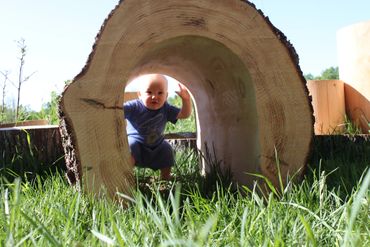
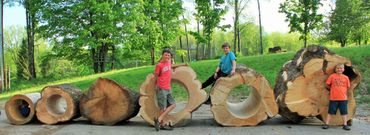
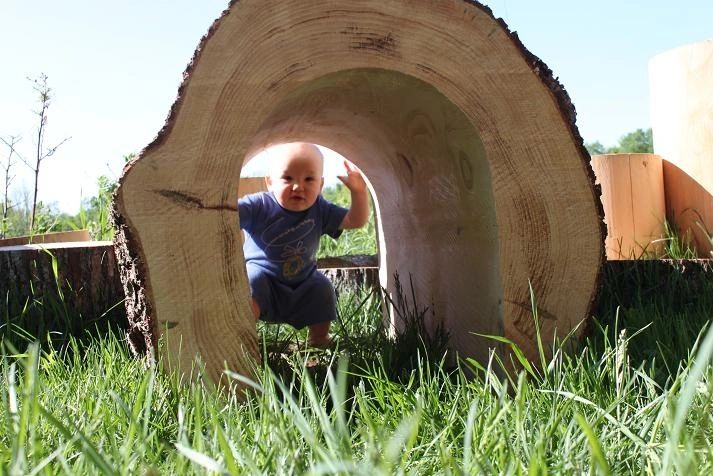
The Sensory Magic of Natural Play: What a Hollow Log Does That Plastic Never Can
There's something that happens when a child — or an adult — encounters a real hollow log for the first time. It's not just play. It's a full-body sensory experience that plastic equipment simply cannot replicate. Here's the science behind why it matters.
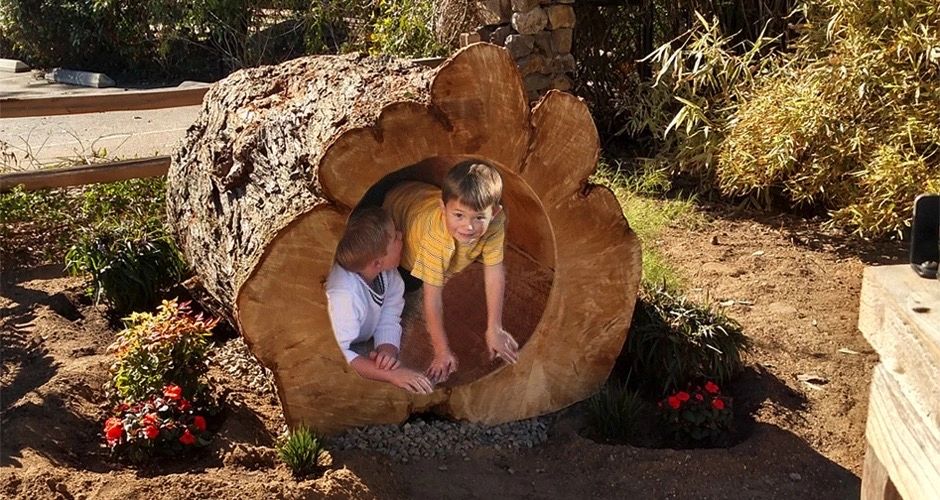
Close your eyes for a moment and think about your favorite outdoor memory from childhood.
Chances are it involves something natural. A creek. A tree you climbed. A fort you built from sticks and leaves. A hollow log you discovered at the edge of the woods and immediately crawled inside.
You probably remember how it felt. The rough bark under your hands. The cool, earthy smell of the interior. The way sound changed when you were inside — muffled, private, yours.
That memory is so vivid because it wasn't just play. It was a full-body sensory experience. And those experiences, researchers now understand, are foundational to how children develop — physically, cognitively, and emotionally.
The Senses That Plastic Playgrounds Miss
Walk through a traditional playground and count the sensory inputs: smooth plastic, primary colors, the same temperature as the air around it, no smell, no texture variation, no sound beyond the squeak of a swing chain.
Now walk through a natural play space with a hollow log at its center.
Touch: Real wood is never uniform. There's bark — rough, ridged, sometimes flaking — and the smooth inner wood worn by weather and time. There are knots, crevices, the soft give of weathered grain. Every surface is different. Every handhold is a small discovery.
Smell: Wood carries the memory of the forest it came from. The earthy, resinous scent of pine. The sweet, faint smell of poplar. The deep, complex fragrance of oak. These are among the oldest scents in human evolutionary memory — we are wired to find them calming, grounding, and alive.
Sound: Knock on a hollow log and it resonates. The sound changes depending on where you knock, how hard, with what. Children discover this within minutes and turn it into music, communication, percussion. The log becomes an instrument.
Sight: Natural wood is visually complex in a way that manufactured materials are not. The grain patterns, the color variation, the way light plays across a textured surface — these engage the visual system in a fundamentally different way than a flat painted surface.
Proprioception: This is the sense we talk about least but use constantly — the body's awareness of its own position in space. Climbing over a log, crawling through it, balancing on its curved surface: all of these challenge and develop proprioceptive awareness in ways that flat, uniform playground equipment cannot.
Biophilia: We Are Wired for This
In 1984, biologist E.O. Wilson introduced the concept of biophilia — the innate human tendency to seek connection with other living systems and the natural world. It's not a preference. It's a biological drive, shaped by hundreds of thousands of years of human evolution in natural environments.
When a child encounters a hollow log, something ancient activates. This is a shelter. This is a den. This is a place that has been used by living things before me and will be used by living things after me. I belong here.
That feeling — of belonging in a natural space — is increasingly rare for children who grow up in urban and suburban environments. Natural play spaces, and the objects within them, are one of the most powerful ways we can restore it.
Research published in the Journal of Environmental Psychology found that children who play in nature-rich environments show:
- Lower cortisol levels (the primary stress hormone)
- Greater attention span and focus when returning to classroom settings
- Higher scores on measures of creativity and divergent thinking
- Stronger social bonds with peers
The hollow log isn't incidental to these outcomes. It's central to them.
The Kid in All of Us
Here's something we've noticed after more than a decade of delivering hollow logs to zoos, schools, parks, and nature centers across North America:
Adults can't resist them either.
We've watched zoo curators in their fifties crouch down and peer into a freshly delivered log. We've seen teachers sit inside a 48" hollow during recess, just to see what it feels like. We've gotten emails from parents who admit they spent more time in the log than their kids did on delivery day.
This isn't surprising. The sensory pull of natural materials doesn't expire at age twelve. It just gets suppressed — by schedules, by screens, by the general pressure to act like an adult.
A hollow log gives everyone permission to stop acting like an adult for a minute.
There's a term for this in developmental psychology: neoteny — the retention of childlike qualities into adulthood. Play, curiosity, wonder. These aren't things we outgrow. They're things we need, at every age, to stay fully human.
Designing for Sensory-Rich Natural Play
If you're designing a natural play space — whether for a school, a park, a nature center, or your own backyard — here are a few principles for maximizing the sensory experience:
Layer textures. Pair a hollow log with boulders, loose materials (sand, wood chips, gravel), and native plantings. The contrast between surfaces multiplies the sensory input.
Create enclosure. The hollow log works partly because it creates a defined, enclosed space — a place that feels separate from the larger world. Supplement it with low plantings, berms, or natural fencing to deepen that sense of enclosure.
Allow for loose parts. Sticks, pinecones, bark pieces, stones — these are the raw materials of imaginative play. A hollow log becomes a kitchen, a laboratory, a treasure vault when children have loose parts to bring inside it.
Let it weather. A new log looks beautiful. A weathered log looks alive. The graying of the wood, the moss that begins to grow in the crevices, the way the bark slowly loosens — these changes are part of the sensory story. Don't fight them.
Position it at child height. A log that children can approach, touch, and enter without adult assistance is infinitely more engaging than one that requires help. For younger children, a 24"–36" diameter log positioned on level ground is ideal. For older children, a larger log with some elevation creates physical challenge.
A Note on Lasting Memories
We make hollow logs. That's the simple version of what we do.
The more honest version is that we make the objects around which memories form. The log a class of second-graders named "The Dragon Cave" and visited every recess for three years. The log at the wildlife center where the red panda always slept, curled in a perfect circle, visible through the viewing window. The log in the backyard that a father and his daughter spent a Saturday afternoon decorating with chalk drawings.
These aren't things we planned. They're things that happen when you put a real piece of the natural world into a space where people — children and adults — are free to encounter it.
That's the sensory magic of natural play. You can't manufacture it. You can only create the conditions for it.
Want to bring that experience to your school, park, or nature center? Explore our full range of hollow logs or build your own custom configuration. We'd love to be part of your story.
Explore Topics
Written by
IC WOOD Team
Content creator and writer sharing insights and stories.