The World's Most Famous Hollow Logs: From Balch Park's Giant Sequoia to Modern Architecture
From a drive-through sequoia in the California mountains to a patented mechanical hollowing process that brings massive natural timber into modern public spaces — the story of the world's most famous hollow logs.
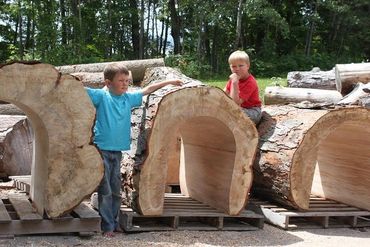
A hollow log is one of the oldest structures on earth. Long before humans built shelters, hollow logs served as dens, nurseries, food caches, and refuges for nearly every class of terrestrial vertebrate. They are, in the most literal sense, nature's original architecture.
But some hollow logs become more than habitat. Some become landmarks.
Balch Park and the Tunnel Log: A Structural Marvel of the Sierra Nevada
In the mountains of Tulare County, California, at an elevation of roughly 6,500 feet, Balch Park preserves one of the most visited natural curiosities in the American West: a fallen giant sequoia (Sequoiadendron giganteum) through which a road was cut in 1937, allowing automobiles to drive directly through the interior of the log.
The tree itself fell of natural causes. Its diameter at the cut point measures approximately 8 feet — wide enough to accommodate a standard passenger vehicle with clearance to spare. The tunnel was hand-cut by park workers using tools that would be considered primitive by modern standards, yet the structural integrity of the log has held for nearly nine decades without mechanical reinforcement.
What makes this possible is the biology of the giant sequoia. The outer sapwood and bark of a mature sequoia are extraordinarily dense and rich in tannins — the same compounds that give the tree its legendary resistance to fire, insects, and fungal decay. The heartwood, by contrast, is softer and more prone to natural hollowing as the tree ages. This means a fallen sequoia can present a structurally sound outer shell surrounding a naturally voided interior — a hollow log of architectural proportions.
The Balch Park tunnel log is not unique in concept. The Wawona Tunnel Tree in Yosemite, felled by a winter storm in 1969, was perhaps the most photographed example of a drive-through sequoia in American history. The Chandelier Tree in Leggett, California — a living coast redwood — still accommodates vehicles today. These trees captured the public imagination for a simple reason: they demonstrated, viscerally and unmistakably, that a hollow log could be a passageway, a threshold, a space that a human body could enter and inhabit.
That idea — the hollow log as inhabitable space — is the foundation of everything IC WOOD builds.
The Engineering Problem: Scale, Safety, and Repeatability
The Balch Park tunnel log is a one-of-a-kind natural event. A tree of that diameter falls in the right place, at the right angle, and happens to be structurally sound enough to survive the impact and the subsequent decades of weathering. You cannot manufacture that. You cannot order it from a catalog.
For most of the twentieth century, that limitation defined the market for large natural hollow logs in public spaces. Zoos, parks, playgrounds, and nature centers that wanted a genuine crawl-through timber experience had two options: find a naturally hollow log of the right size and hope it was structurally sound, or substitute a concrete or fiberglass replica that looked vaguely like wood but offered none of the sensory, ecological, or material authenticity of the real thing.
Neither option was satisfactory. Naturally hollow logs of sufficient diameter are rare, structurally unpredictable, and impossible to source consistently. Concrete and fiberglass replicas — however well-crafted — are immediately identifiable as artificial by the animals and children who interact with them. The scent is wrong. The texture is wrong. The weight distribution is wrong. The thermal mass is wrong. Everything that makes a hollow log a hollow log is absent.
IC WOOD founder Bob Lauterbach identified this gap and spent years developing a solution: a patented mechanical hollowing process that could take a full-diameter salvaged hardwood log — the kind of massive, structurally sound timber that comes from hazard tree removal programs — and engineer a precise, dimensionally consistent hollow interior without compromising the structural integrity of the outer shell.
The Patented IC WOOD Process: Engineering What Nature Takes Centuries to Produce
The IC WOOD mechanical hollowing process begins with log selection. Every log starts as a salvaged hazard tree — a tree removed from a residential, municipal, or institutional property because it poses a risk of failure. These trees are typically mature hardwoods: oak, ash, maple, elm, and similar species with dense, durable outer wood and a heartwood core that has begun the natural process of decay or desiccation.
The selection criteria are exacting. The outer shell must meet minimum wall-thickness specifications at every point along the log's length. The wood must be free of through-cracks, significant structural voids, or evidence of advanced fungal colonization in the load-bearing zones. Logs that do not meet these criteria are rejected for hollow log production and redirected to other uses.
Once a log is selected, the mechanical hollowing process removes the interior core with precision tooling, leaving a wall of consistent thickness that distributes load evenly around the circumference. The result is a hollow cylinder of native hardwood — bark intact on the exterior, smooth and splinter-free on the interior — that can support the weight of multiple adults simultaneously.
This is the engineering insight that the Balch Park tunnel log demonstrates in nature and that IC WOOD replicates by design: the structural strength of a large-diameter log resides almost entirely in the outer shell. The interior is, in a meaningful sense, redundant to the structural function of the log. Removing it does not weaken the piece — it creates a space that humans and animals can inhabit while the outer shell continues to perform its load-bearing role.
From the Sierra Nevada to Modern Public Spaces
The logs IC WOOD produces today are installed in more than 130 zoos, aquariums, nature centers, public parks, and educational institutions across North America. They range in diameter from 18 inches — suitable for children's playgrounds and small-animal exhibits — to 72 inches, the scale at which a hollow log becomes a genuine architectural element: a tunnel, a den, a threshold that a person walks through rather than crawls through.
At that scale, the parallel to Balch Park becomes explicit. A 72-inch IC WOOD log installed in a zoo habitat or a public park is, structurally and experientially, the same thing as the Balch Park tunnel log — a massive native hardwood cylinder, hollow at its core, with an outer shell dense enough to bear the loads placed upon it and a surface authentic enough to trigger the same behavioral responses in animals and the same sense of wonder in children.
The difference is that IC WOOD logs are engineered to a consistent standard, sourced from a documented supply chain, and manufactured to meet ASTM F1292 and ASTM F1487 safety specifications for playground and public-use installations. They can be ordered in specific diameters and lengths. They can be delivered on a schedule. They can be installed by a standard grounds crew without specialized equipment.
The Balch Park tunnel log required a fallen giant sequoia, a road crew with hand tools, and eighty-seven years of good fortune. IC WOOD requires a phone call.
Why the Hollow Log Endures
There is a reason the Balch Park tunnel log has been photographed millions of times. There is a reason the Wawona Tunnel Tree was mourned when it fell. There is a reason children run toward hollow logs on playgrounds and animals investigate them within minutes of installation in a new exhibit.
The hollow log is not a novelty. It is one of the most ancient and universally recognized forms in the natural world — a space defined by living material, shaped by time, and scaled to the body of the creature that inhabits it. It communicates shelter, mystery, and invitation in a language that requires no translation across species or cultures.
IC WOOD exists to make that experience available at scale, safely, and from a documented sustainable supply chain. The Balch Park sequoia showed what was possible. IC WOOD made it repeatable.
IC WOOD The Hollow Log Company manufactures patented mechanical hollow logs for zoos, aquariums, public parks, playgrounds, and educational institutions. All logs are sourced from salvaged hazard trees and manufactured to ASTM F1292 and ASTM F1487 specifications. Custom diameters and lengths available. Contact us to discuss your project.
Explore Topics
Written by
IC WOOD Team
Content creator and writer sharing insights and stories.